| History - 49th A.I.B. - Service Co. |
 | Index
|
| Next |
| Index
|
| Next |
|
(Pages 18-20)
|
|
At 2330 on the 11th Jan. 1945 we received a message to be ready to leave in an hour. It didn't take us long to get ready because we had already learned that before retiring at night you should be all loaded up and ready to roll at any time. We pulled out at 0030 the next morning.
Down through Verdun, into Alsace-Lorraine, moved our column, entering demolished Louvigny, France at 1530, travelling a distance of approximately 110 miles. We soon moved out of our first billet because there wasn't any draft in the chimney and when you built a small fire the cold breeze that whipped through the broken window panes nearly put it out.
At the next billet area that we chose we broke a hole in the wall where there once was a fire place. To our surprise this fire place worked very well. The next thing we did was to get some glass from some other buildings in the village (there were a few panes of glass left) and placed them in our window frames. Next came shutters for black out purposes and warmth. By going out every day and chopping wood we had enough to keep fairly warm for out remaining stay at Louvigny.
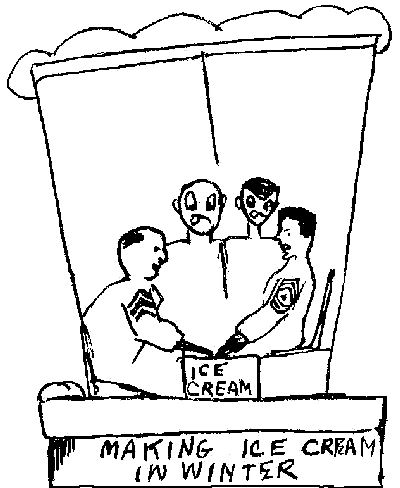
It was at Louvigny that 'Gravy' and 'Eddie' mixed up some homemade ice cream with limited facilities such as canned fruit, canned milk, sugar, and snow. To everyone's surprise the ice cream tasted good.
At Louvigny we also white-washed our vehicles so that they would blend with the surroundings.
Everything was going along fairly well until the snow began melting and the
|
dead cattle began to thaw out. The stench from the cattle was sickening. We had our 10 ton Wrecker drag the dead cattle to the outskirts of the village. Not only did the melting of the snow disclose dead cattle but it began to leak through the ceiling. Upon awakening one morning we found ourselves laying in two inches of water. That morning we moved to different rooms of the house and finished our stay in Louvigny in these fairly dry rooms.
Then on February 2nd, the long awaited alert came and we mounted up on our vehicles and pulled out at 1328. This time we rolled through Belgium up toward Maastricht, Holland, through devastated Liege and rolled into the vicinity of Sibbe, Holland at 1700, 3rd Feb. We slept in our vehicles on the side of the road that night and moved to Ijzeren, Holland a short distance away, in the morning.
'Gravy', and 'Eddie' slept in the half-track, which was parked in a barn. 'Olie' 'Art' and Sarnell slept in the hay mound. After several days sleeping in the hay mound we decided we were going to stay in Ijzeren for awhile so we asked one of the civilians if we could live in their home. They said they would enjoy having us. We will never forget the hospitality of the Dutch. Cherry and apple pies, with coffee, was brought to us every night after a day's work, and coming from not too plentiful stocks, gave us a warm feeling about the people. In return for their generosity we gave them gum, candy, cigarettes, and soap.
|
-- 18 --
|

Finally after three attempts to move from Ijzeren we departed at 0800 on 21st Feb. Entering Germany for the first time it was evident that this was part of the Third Reich because of leveled towns and enemy equipment abandoned and smashed. We crossed the frontier again and occupied a monastery at Klooster Libosch, Holland.
Our next move, was over the Roer River which was very insignificant where we crossed, amounting to nothing more than a creek. The next German towns we rolled through were Hucklehoven, Kaldenkirchen and Aldekerk.
Lintfort was our next stop. Up the road our Battalion hit on to the toughest pockets of resistance encountered on the Western Front at that time. Though the Battle of Rhineberg was not widely publicized our units, with the help of tanks, crushed one of the last organized resistance that remained west of the Rhine.
At Lintfort our section maintained a modified rest center when combat conditions became long and arduous and many men, instead of being evacuated, with combat fatigue, were caught in time and sent to our unit. Here hot meals, hot baths, and a good sleep in a bed were of great value in cutting down the number of combat fatigue cases to a minimum.
Just before leaving Lintfort 'Art' left us to go back to the States to attend Officers Candidate School for the Judge Advocate General at Michigan University.
We departed Lintfort on the 11 March and went back to Venlo, Holland to get new equipment and men in order to carry on in combat.
|
A realization of how much suffering the Hollanders had endured came with the sight of hungry men, women, and children who waited for leftovers from our mess.
At Venlo we got our administrative record straightened out and prepared for further movement. 'Mac' took over the duties of the 1st Sgt.
when 'Gravy' went to Paris. At Venlo, William L. 'Dusty' Rhodes joined our section after being in the Fuel and Lube Section since Ijzerel1.
The trip from Venlo was supposed to be a brief hop to an assembly area, prior to crossing the Rhine River. We pulled out of Venlo at 0015 on the 27th March and kept rolling and rolling until we heard planes strafing the front of our convoy. 'Gravy' said, 'I guess the Germans didn't read the "Stars and Stripes" stating that we had air superiority." Our convoy halted on the road winding east from Venlo while our 50's blasted away at the planes.
Came the dawn, we made our way through roads jammed with convoys hurrying to the front and took our place on the Treadway Bridge leading across the Rhine River. After crossing the Rhine River our unit got separated from the rest of the convoy so we continued on our way by ourselves. We passed many units that looked like they were preparing to leave immediately to go into action. The 'long toms' opened up and then a little further up the road the machine guns began to blast away. We still continued on our way but decided to turn around when we began to hear small arms firing.
The reason that we turned around was because when we left Venlo we were told that we would by no means cross the Rhine River. Our first stop across the Rhine was Friedrichsfeld, Germany. We arrived there at 1300 on the 29th March, 1945. Our first fox holes were dug here, but definitely not our last. From Friedrichsfeld we went to Compermannshof and then Selm. At Selm we were told that our next mission was Hamm, a great railroad and communication center. If we were successful with this mission we would continue on to Berlin.
|
-- 19 --
|
On April 1st, 1945 at 1100 we departed Selm and joined the 2nd Armored Division and rolled on toward Hamm. Our Division was pulled out of convoy and sent to the Ruhr Pocket - down toward 180,000 trapped Germans, among them the 116th Panzer Division. At Salzkotten we got a little rest and continued on our way through several towns in the area of Soest. At Hammerde we remained for a few days while the forward units penetrated
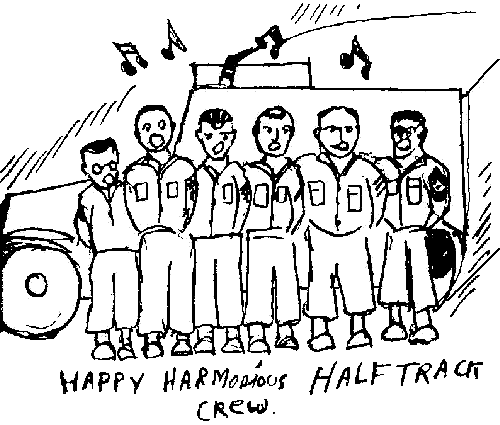
Unna. The Ruhr was fairly well cleaned up and our next stop was Wolfenbuttel. At Wolfenbuttel we had the better than usual billets, but of course we didn't enjoy them long. Again we had orders to move. This time we left at 1530 on the 14th Apr. 1945. We moved to Halberstadt. At Halberstadt we met recently liberated British Prisoners of War. We gave them all the cigarettes and candy that we could get and invited them to supper. They said that they were afraid to eat too much food because all they had eaten was grass soup for the past several months. They were a very happy bunch of boys that night. The next day they came back and told us that they were leaving for England the following day. Thomas P. Moore, a radio operator replacement for 'Art' joined us at Halberstadt, and became a member of the Happy Harmonious Half-track Crew.
Our next stop was Westerhausen where we remained overnight while our forward unit took over Blankenburg. The roadside from Westerhausen to Elbingerode proved the efficiency of the American Air Force.
|
Dead horses, knocked out vehicles, some still burning as we passed, abandoned gun positions, indicated that some P-47 squadron had a field day.
The long climb over narrow, winding roads and around blind corners as we pushed south toward Elbingrode proved to be very scenic. We arrived at our destination, Elbingerode, which is located in the Harz Mountains, on the 24th April at 11 00. We settled down at Elbingerode for about two weeks. Blane 'Handle-bar' Martin joined our section here. 'Handle-bar' transported our mail in a 3/4 ton truck. He had previously been with the Ammunition Section since Ijzeren, Holland. We left Elbingerode on 7th May and arrived at Uslar, Germany the same day. Upon dismounting from our vehicles we heard the V-E Day was going to be the 9th of May. Of course we were all happy to hear this news but we still realized that there still was the Pacific.
Once again we loaded up our vehicles and departed Uslar, Germany at 0349 4th June. We travelled 318 miles in two days to Rokycany, Czechoslovakia where we are located at the present time. We are now wondering where we will go from here - Army of Occupation, C.B.I. The following is how we line up for our points. Our points are based on only one battle star, but there is hopes for two additional at 5 points apiece.
'Gravy' 79, 'Mac' 50, 'Eddie' 54, 'Olie' 47, Sarnell 37, 'Stew' 37, Moore 23, 'Handle-bar' 55, 'Dusty' 17.
|
-- 20 --
Page 21 is blank.
|

